Blog
Enterprise Brand Monitoring: A Complete Guide to Protecting Reputation, Revenue, and Trust
For enterprise brands, reputation no longer lives in one place. It spreads across review sites, social platforms, news coverage, marketplaces, forums, app stores, search results, video platforms, and private communities. A single misleading post, fake domain, counterfeit listing, or customer complaint can move from obscurity to visibility in a matter of hours.
That is why enterprise brand monitoring has become a core business function, not just a marketing add-on.
At the enterprise level, brand monitoring is about far more than tracking mentions. It is the process of continuously identifying, analyzing, and responding to signals that affect how your brand is perceived, discussed, misused, or threatened across digital channels. The strongest enterprise programs connect those signals to action across PR, customer experience, legal, trust and safety, ecommerce, and cybersecurity.
This guide explains what enterprise brand monitoring is, why it matters, how it differs from basic monitoring, and how to build a system that scales.
What Is Enterprise Brand Monitoring?
Enterprise brand monitoring is the ongoing process of tracking brand-related activity across digital and public channels to protect brand equity, reduce risk, and improve business decision-making.
That includes monitoring:
- Brand mentions — References to your company, products, executives, campaigns, and trademarks across social media, press, blogs, communities, and review platforms.
- Brand perception — Sentiment, tone, themes, share of voice, and changes in how people talk about your brand over time.
- Brand misuse — Impersonation, fake websites, counterfeit products, unauthorized sellers, misleading ads, phishing attempts, and trademark abuse.
- Competitive context — How your brand compares with competitors in visibility, sentiment, complaints, review trends, and narrative momentum.
- Operational risk signals — Emerging product complaints, service failures, misinformation, and viral content that may escalate into a larger brand issue.
At the enterprise level, it becomes a cross-functional intelligence layer that supports governance, compliance, brand safety, and revenue protection.
Why Enterprise Brand Monitoring Matters
1. Brand risk now moves faster than internal workflows
Modern brand conversations happen in real time. If teams rely on weekly reports or manual checks, they will always be behind.
2. Reputation and revenue are tightly linked
For enterprise organizations, trust affects customer retention, conversion, partnership value, hiring strength, and investor confidence.
3. Threats are no longer limited to public criticism
Monitoring also covers phishing domains, fake social accounts, app impersonation, counterfeit listings, affiliate abuse, and misleading paid ads.
4. Enterprises need visibility across regions and business units
Different markets, languages, platforms, and regulations demand a structured and scalable approach.
5. Monitoring creates competitive intelligence
It can reveal recurring complaints about competitors, category pain points, message gaps, and unmet customer expectations.
Enterprise Brand Monitoring vs. Basic Brand Monitoring
Basic monitoring focuses on observation—tracking mentions, hashtags, and reviews. Enterprise monitoring focuses on decisions: routing issues to the right teams, prioritizing risk, tracking escalation, and connecting brand signals to outcomes.
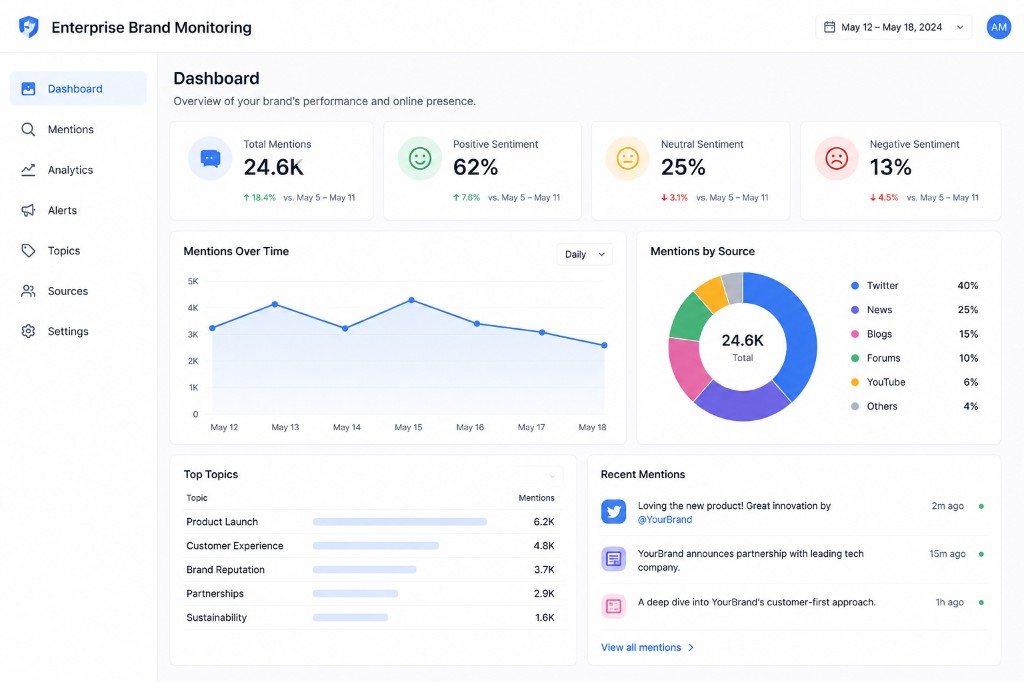
Enterprise monitoring usually includes: multilingual coverage, AI-assisted classification, visual and logo detection, anomaly alerts, competitor benchmarking, governance and access controls, workflow integration with CX, PR, legal, and security teams, and executive reporting.
The Core Channels Enterprises Should Monitor
Prioritize channels based on business impact.
- Social media platforms — Fast-moving sources of sentiment shifts, campaign feedback, product complaints, and viral narratives.
- Review and rating platforms — App stores, G2, Trustpilot, Google reviews, and category-specific directories.
- News and media coverage — Press mentions and industry publications influence authority and trust.
- Forums and communities — Reddit, Discord, niche communities, and support forums surface candid brand feedback.
- Marketplaces and ecommerce listings — Essential for counterfeit goods, unauthorized resellers, MAP violations, and product copycats.
- Domains, search, and paid ads — Critical for phishing domains, brand bidding abuse, deceptive landing pages, and impersonation campaigns.
- Video and visual channels — Logos, product imagery, and visual brand references across short-form video and creator content.
What an Enterprise Brand Monitoring System Should Include
- Real-time data collection — Pull data continuously from prioritized channels.
- Entity and keyword mapping — Track branded terms, product names, trademarks, and competitor references.
- Sentiment and narrative analysis — Identify themes, intensity, emerging narratives, and shifts over time.
- Risk detection and alerting — Flag anomalies such as complaint spikes, misinformation, impersonation, or suspicious activity.
- Workflow integration — Route alerts into CRM, ticketing, Slack, incident response, or legal workflows.
- Reporting by stakeholder — Business-level dashboards for executives, media narratives for PR, issue clusters for CX.
- Governance and compliance controls — Permissions, auditability, data handling rules, and region-specific compliance.
How to Build an Enterprise Brand Monitoring Framework
- Step 1: Define what you are protecting — Company and product names, trademarks, executive identities, campaign names, domains, visual brand elements.
- Step 2: Separate goals by business function — Marketing, PR, customer support, legal, and security each monitor for different reasons.
- Step 3: Prioritize channels by risk and impact — Start with channels that influence revenue, trust, and escalation risk.
- Step 4: Establish alert thresholds — Informational, moderate concern, urgent response, critical escalation.
- Step 5: Assign ownership — Every alert type should have a clear owner, backup owner, and escalation path.
- Step 6: Build a response playbook — Define how to handle service spikes, misinformation, fake accounts, counterfeit listings, and coordinated attacks.
- Step 7: Review and refine monthly — Evolve with platform shifts, threat patterns, and business priorities.
Key Enterprise Brand Monitoring KPIs
- Share of voice — How visible your brand is compared with competitors.
- Sentiment trend — Whether brand perception is improving, declining, or polarizing.
- Time to detect — How quickly the system identifies a potential issue.
- Time to respond — How quickly the right team takes action.
- Issue recurrence rate — Whether the same complaint or risk keeps returning.
- Brand abuse volume — Fake listings, phishing attempts, impersonation profiles detected.
- Resolution or takedown rate — How many confirmed threats were successfully removed.
- Revenue or retention impact — Correlation with churn, conversion, support load, or sales.
Common Enterprise Brand Monitoring Challenges
- Too much data, not enough prioritization
- Fragmented ownership across teams
- Overreliance on vanity metrics
- Incomplete channel coverage (missing forums, marketplaces, app stores, search abuse)
- Weak actionability—dashboards without routing and response logic
- Global complexity—languages, local platforms, privacy rules, regional enforcement
Best Practices for Enterprise Brand Monitoring
- Monitor for both reputation and abuse
- Combine AI with human review
- Focus on narrative shifts, not just mention spikes
- Integrate monitoring into decision systems (support, PR, legal, product, security)
- Build market-specific coverage for global brands
- Tie reporting to business impact
The Future of Enterprise Brand Monitoring
Enterprise monitoring is moving toward: predictive reputation scoring, multimodal detection across text, image, audio, and video, AI-generated first-response drafts, stronger misinformation and deepfake detection, tighter connection between monitoring, compliance, security, and CX, and executive dashboards that connect brand perception to business performance.
FAQ: Enterprise Brand Monitoring
What is enterprise brand monitoring?
Enterprise brand monitoring is the continuous tracking of brand mentions, perception, misuse, and risk signals across digital channels to protect reputation, trust, and revenue.
Why is enterprise brand monitoring important?
It helps large organizations detect reputation issues early, identify brand abuse, respond faster to crises, and connect brand health to business performance.
What channels should enterprises monitor?
Enterprises should typically monitor social media, review sites, marketplaces, forums, news sites, app stores, search results, paid ads, and suspicious domains.
How is enterprise brand monitoring different from social listening?
Brand monitoring focuses on tracking direct brand-related signals and risks. Social listening expands further into audience behavior, category trends, and broader market conversations.
What are the main risks enterprise brand monitoring can detect?
It can detect negative sentiment spikes, product complaints, misinformation, fake accounts, phishing domains, counterfeit listings, brand impersonation, and unauthorized reseller activity.
Which teams should own enterprise brand monitoring?
The most effective programs are cross-functional. Marketing, PR, customer support, legal, trust and safety, and security teams usually share ownership based on alert type and response needs.
What KPIs matter most in enterprise brand monitoring?
Important KPIs include share of voice, sentiment trend, time to detect, time to respond, abuse volume, resolution rate, and business impact metrics tied to churn, conversion, or revenue protection.
Can AI improve enterprise brand monitoring?
Yes. AI can help classify mentions, detect anomalies, identify visual brand misuse, prioritize alerts, and surface patterns faster than manual review alone.
Related Services
Enterprise brand monitoring relies on data from many channels. Explore our solutions:
- Review & Social Data — Monitor reviews and social sentiment
- Web Scraping — Extract data from any website at scale
- E-commerce Data — Marketplace and product data
- Market Intelligence — Competitive and industry insights
Conclusion
Enterprise brand monitoring is no longer a nice-to-have for large organizations. It is part brand intelligence system, part risk management function, and part operational control layer.
The brands that do this well are not simply collecting mentions. They are building a system that detects problems early, routes them quickly, gives teams shared visibility, and links reputation signals to business outcomes.
That is what separates passive monitoring from enterprise-grade monitoring. A high-performing program helps protect trust, reduce brand abuse, improve customer experience, and give leadership a clearer view of what is happening in the market before small issues become expensive ones.
Contact us to learn how our data extraction and monitoring solutions can support your enterprise brand protection strategy.