Blog
Competitive Price Intelligence: The Ultimate Guide to Smarter Pricing Strategies
Pricing is one of the most powerful factors influencing customer decisions. In today's digital marketplace, shoppers can compare prices across dozens of stores in seconds. For businesses, pricing mistakes can instantly drive customers to competitors.
This is where competitive price intelligence becomes essential.
Instead of guessing what your competitors are charging, price intelligence uses data to monitor, analyze, and respond to market pricing in real time. Businesses can track competitor prices, promotions, stock availability, and discount patterns to make smarter pricing decisions.
In this guide, we'll explore what competitive price intelligence is, how it works, and how businesses can use it to build a stronger pricing strategy.
What Is Competitive Price Intelligence?
Competitive price intelligence is the process of collecting, analyzing, and acting on competitor pricing data to inform your own pricing strategy.
This process involves tracking factors such as: competitor product prices, discounts and promotions, pricing changes, shipping costs, marketplace listings, and stock availability.
Instead of occasional manual checks, competitive price intelligence relies on continuous monitoring and analytics. The goal is simple: make pricing decisions based on data rather than assumptions.
Why Competitive Price Intelligence Matters
Businesses that ignore competitor pricing risk losing customers and revenue.
1. Customers Constantly Compare Prices
Online shoppers frequently compare prices across multiple websites before buying. Price intelligence helps ensure your pricing remains competitive.
2. Protect Profit Margins
Competitive price intelligence helps companies identify the optimal pricing range rather than blindly undercutting competitors.
3. Improve Pricing Strategy
Analyze patterns such as competitor discount timing, seasonal promotions, price elasticity, and market demand changes to build data-driven strategies.
4. Enable Dynamic Pricing
With competitive price intelligence, businesses can match competitor pricing, respond to discounts, and optimize promotional pricing.
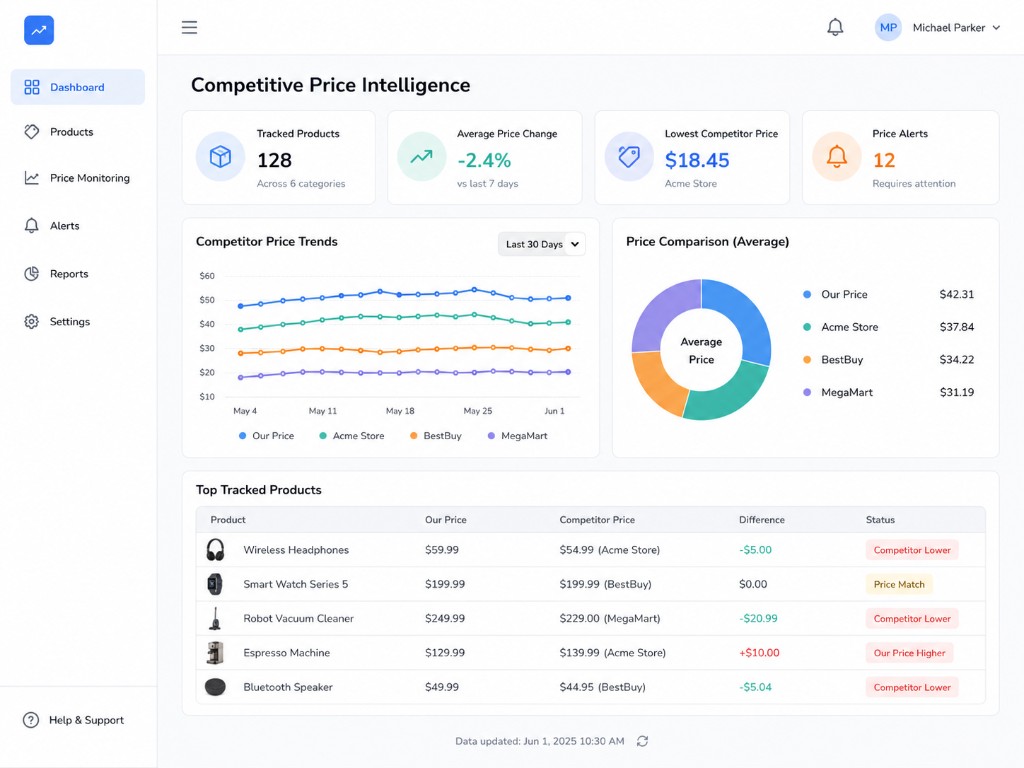
How Competitive Price Intelligence Works
Competitive pricing intelligence follows a structured process.
Step 1: Competitor Identification
Identify competitors whose pricing matters most—direct product competitors, marketplace sellers, substitute brands, and regional competitors. Tracking irrelevant competitors can distort insights.
Step 2: Data Collection
Collect pricing data from ecommerce websites, online marketplaces, retail stores, price comparison sites, and promotional catalogs. Many companies use web scraping and price monitoring software to automate this.
Step 3: Price Monitoring
Continuously track price changes, discount percentages, flash sales, promotional bundles, and stock availability.
Step 4: Data Analysis
Analytics tools transform raw data into actionable insights: competitor price trends, price positioning vs market average, discount frequency, and category-level pricing.
Step 5: Pricing Strategy Optimization
Use insights to match competitor prices, implement dynamic pricing, launch targeted discounts, and adjust margins.
Key Metrics Used in Competitive Price Intelligence
- Competitive Price Index (CPI) — Measures how your price compares with competitors. CPI > 1 means priced higher; CPI < 1 means priced lower.
- Price Change Frequency — Reveals dynamic pricing behavior, promotional cycles, and price sensitivity.
- Discount Depth — Average discount percentage, frequency of sales events, seasonal promotions.
- Market Price Range — Minimum, average, and maximum prices help identify optimal pricing zones.
Competitive Price Intelligence for Ecommerce and Retail
Price intelligence is particularly valuable in ecommerce and retail.
- Ecommerce — Monitor competitors across marketplaces, adjust pricing dynamically, optimize buy-box positioning.
- Retail Chains — Benchmark store pricing, align regional strategies, track competitor promotions.
- Manufacturers and Brands — Maintain price consistency, detect unauthorized discounting, enforce MAP.
Tools Used for Competitive Price Intelligence
Common features include competitor price monitoring, automated web scraping, dynamic pricing recommendations, price alerts, and analytics dashboards. Popular categories: price monitoring platforms, retail analytics software, ecommerce intelligence tools. Automation is critical because manual tracking becomes impossible at scale.
Explore our price intelligence and ecommerce data solutions.
Best Practices for Implementing Competitive Price Intelligence
- Focus on Relevant Competitors — Track the ones that influence customer decisions.
- Automate Data Collection — Automated tools ensure real-time insights and scalability.
- Combine Pricing with Market Insights — Integrate demand trends, product availability, and customer behavior.
- Avoid Price Wars — Use pricing intelligence to optimize value positioning, not just undercut.
Common Challenges in Competitive Price Intelligence
Data accuracy (incorrect competitor matching), rapid market changes (prices changing multiple times daily), and large data volumes. Advanced analytics and automation help solve these issues.
Future of Competitive Price Intelligence
Key trends include AI-driven pricing analytics, predictive price forecasting, automated dynamic pricing, and real-time competitor monitoring. As ecommerce competition grows, businesses will rely even more on data-driven pricing strategies.
FAQ: Competitive Price Intelligence
What is competitive price intelligence?
Competitive price intelligence is the process of collecting and analyzing competitor pricing data to improve pricing strategies and stay competitive in the market.
How does competitive price intelligence work?
It works by monitoring competitor prices across marketplaces, analyzing price trends, and adjusting pricing strategies based on market insights.
Why is price intelligence important for ecommerce?
Price intelligence helps ecommerce businesses remain competitive, optimize margins, and respond quickly to competitor pricing changes.
What tools are used for price intelligence?
Businesses use price monitoring software, web scraping tools, and retail analytics platforms to track competitor prices and analyze market trends.
What is the difference between price monitoring and price intelligence?
Price monitoring tracks competitor prices, while price intelligence includes analysis, insights, and strategy optimization based on that data.
External Resources
Conclusion
Competitive price intelligence has become a core capability for modern businesses. With customers comparing prices constantly and markets changing rapidly, relying on intuition is no longer enough.
By implementing competitive price intelligence, businesses can optimize pricing strategies, protect profit margins, respond quickly to competitors, and deliver better value to customers.
In a data-driven marketplace, competitive pricing intelligence is not just helpful—it's essential. Contact us to learn how our price intelligence solutions can help.